
What Does Ontario WSIB Cover for SAWP Workers – and Where Can Private Coverage Help?
This article addresses Ontario WSIB coverage and is primarily relevant to Ontario agricultural employers using the Seasonal Agricultural Worker Program (SAWP). It is not a guide to workers’ compensation requirements in other Canadian provinces or territories.
Imagine (for many Canadian businesses, it’s not hard to) that a worker in your bunkhouse gets hurt on a Tuesday night.
Once the immediate aid is handled, you, as a business leader, have about 10 minutes before someone asks you who pays.
And the answer? It depends. Coverage depends on several factors, including one that may surprise you: exactly where that worker was standing when it happened.
For a lot of employers, that's the first time anyone's ever spelled out where that particular line falls, and many only learn when something happens.
That line matters more than most of the coverage guides floating around suggest. For eligible SAWP workers, WSIB policy expressly extends coverage to leisure time, meals, and sleep in employer-provided quarters. (Coverage is still claim-specific and subject to policy exceptions.)
SAWP workers are generally not covered when participating in recreational activities away from the employer’s premises.
Everything on the other side of that line is either covered by a private plan, or it isn't covered at all. That’s important to understand, and how you communicate it to your foreign workers matters.
Who Pays What – By Situation
General Ontario information only. WSIB decides each claim based on the facts. Private coverage depends on the specific plan.
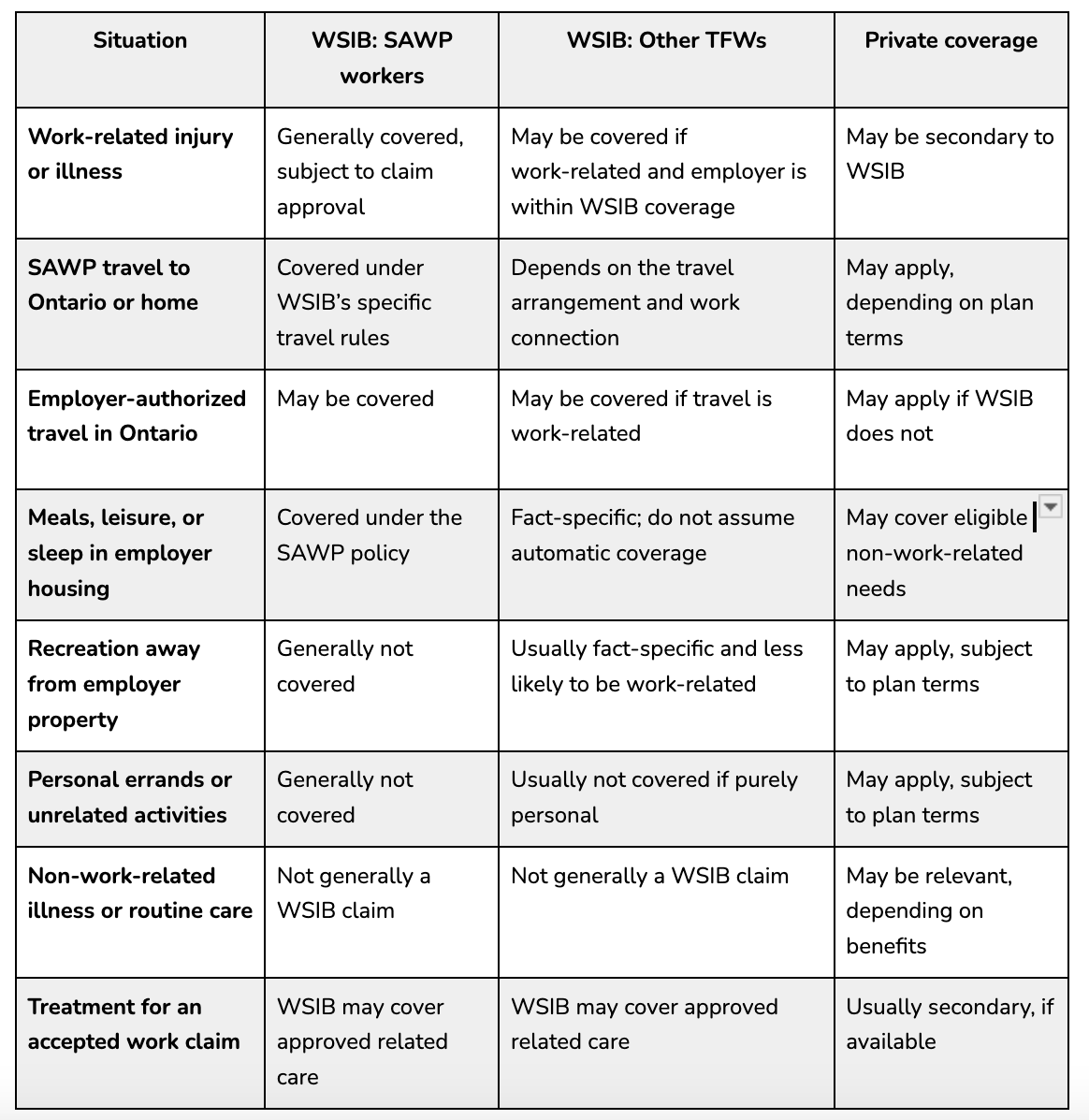
Private coverage may be important when an illness or injury is not work-related or does not qualify for WSIB benefits. But employers and workers should always review the specific policy, since private coverage is not automatic and benefit terms vary.
But there are two things to note, because neither one is obvious from reading WSIB's policy manual on its own.
Employer premises can matter—but they are not the only factor
For eligible SAWP workers, WSIB policy extends coverage beyond scheduled work time. It extends to leisure, meals, and sleep in employer-provided quarters.
But this doesn’t mean every incident on an employer’s property is automatically covered, or that every incident away from the property is automatically excluded.
WSIB decides entitlement based on the facts of the claim and whether the injury or illness arose out of and in the course of employment.
For example, WSIB states that SAWP workers are generally not covered when participating in recreational activities away from the employer’s premises. The policy also identifies exclusions for personal-property repair and other activities unrelated to employment.
Not every stream gets the same paperwork
Before you assume the SAWP rule covers your entire work crew, note that that explicit, generous, sleep-and-meals-included language is a SAWP-specific policy.
This means that if your workers came in through the broader Agricultural Stream, or you're running a food-processing operation on the low-wage stream, WSIB hasn't written you the same rule.
That doesn't mean you're worse off. The general principle WSIB applies to every worker in the province points in the same direction: employer-controlled premises and work-related activity are covered. Personal and recreational activity isn't.
But it's a different legal footing. WSIB's general “on/off premises” test asks whether a location is one “the worker is entitled to be, including entrances, exits, stairs, elevators, lobbies, parking lots, passageways and roads controlled by the employer.”
An on-site bunkhouse attached to the operation clears that test easily. A rented house down the road is a harder call — one WSIB's general policy doesn't spell out the way it spells out the SAWP quarters rule.
What does this mean practically? If your workers are SAWP, you're standing on a named rule. If they're not, you're standing on the same logic, applied case by case, without a rule that names your situation the way it names SAWP's.
An important note: confirm your WSIB registration obligations
Most Ontario businesses with employees must register with WSIB within 10 calendar days of hiring their first employee.
Whether coverage is mandatory depends on the employer’s business activity and applicable WSIB classification.
Employers should not assume that having seasonal, temporary, family, or foreign workers automatically answers their registration question. Confirm your organization’s coverage status directly with WSIB, especially if your operation includes multiple business activities or uses contractors.
What does WSIB pay?
For an accepted work-related injury or illness claim, WSIB may provide approved health-care benefits and loss-of-earnings benefits, subject to its entitlement rules.
For SAWP workers, WSIB generally uses short-term average earnings for the remainder of the worker’s contract.
Whether a worker receives full or partial loss-of-earnings benefits depends on the individual claim, including medical restrictions, available suitable work, and the worker’s return-to-work circumstances.
In specified situations – such as when WSIB determines a worker is permanently unable to return to agricultural work in Ontario – WSIB may assess suitable work using opportunities in the worker’s home-country labour market.
What may fall outside WSIB coverage?
WSIB benefits apply to accepted claims for work-related injuries and illnesses. They are not a general health-insurance plan for every medical need a worker may have.
For an accepted claim, WSIB may cover necessary and approved health-care costs related to the workplace injury or illness. This coverage can include medical treatment, hospitalization, prescription drugs, assistive devices, and (in some cases) dental care that’s directly related to the workplace injury.
It’s important to note that coverage may not apply where an illness or injury is unrelated to work, or where a worker is engaged in an excluded or purely personal activity. Similarly, it may not apply where the facts don’t establish that the injury arose out of and in the course of employment.
For SAWP workers, WSIB specifically states that recreational activities away from the employer’s premises, personal-property repair, and other activities unrelated to employment are generally not covered.
If WSIB does not apply, the worker’s access to care or financial protection may depend on other public coverage and on the specific terms of any private health or travel plan.
But none of this replaces knowing what you should do once an injury happens — reporting steps, timelines, what the worker needs to hear from you in the moment.
The FWCHP Can Help You Understand Coverage Gaps
WSIB can provide important protection for accepted work-related injuries and illnesses.
But it’s not designed to function as general health coverage for every illness, injury, or medical need a worker may have.
When WSIB does not apply, the worker’s protection may depend on public coverage and the specific terms of any private health or travel plan.
The FWCHP can help employers understand the types of health coverage available to foreign workers and select a plan that fits their workforce’s needs.
Frequently Asked Questions
Is a foreign worker covered by WSIB if they’re injured in employer-provided housing?
For eligible SAWP workers, WSIB policy specifically covers leisure time, meals, and sleep in employer-provided quarters. For other temporary foreign workers, coverage in employer-provided housing is fact-specific. WSIB considers the connection to employment, employer control over the accommodation, the activity involved, and other circumstances of the claim.
Does WSIB cover a foreign worker hurt during recreational activity?
For SAWP workers, WSIB policy says recreational activity away from the employer’s premises is generally not covered. For other workers, coverage depends on the facts and the connection between the activity and employment
Is WSIB coverage mandatory for Ontario farm employers?
Most Ontario businesses with employees must register with WSIB within 10 calendar days of hiring their first employee. Whether a particular farm employer must register depends on its business activity and WSIB classification. Employers should confirm their status directly with WSIB.
Does WSIB cover prescription drugs or dental care?
For an accepted workplace injury or illness claim, WSIB may cover necessary and approved health-care costs related to that claim. This can include prescription drugs and, where directly related to the workplace injury, dental treatment. WSIB is not a general health plan for routine or non-work-related medical expenses.
Disclaimer: This article provides general information about Ontario WSIB policy and is not legal, insurance, immigration, or claims advice. The WSIB decides entitlement based on the facts of each claim and the applicable law and policy. Private-plan coverage depends on the specific policy’s terms, conditions, exclusions, eligibility requirements, and coordination-of-benefits rules. Employers and workers should contact WSIB or a qualified legal, insurance, or claims professional for advice about a specific situation.
Looking to provide your foreign workers with the necessary healthcare coverage?
Click through the video below to learn about the FWCHP.